

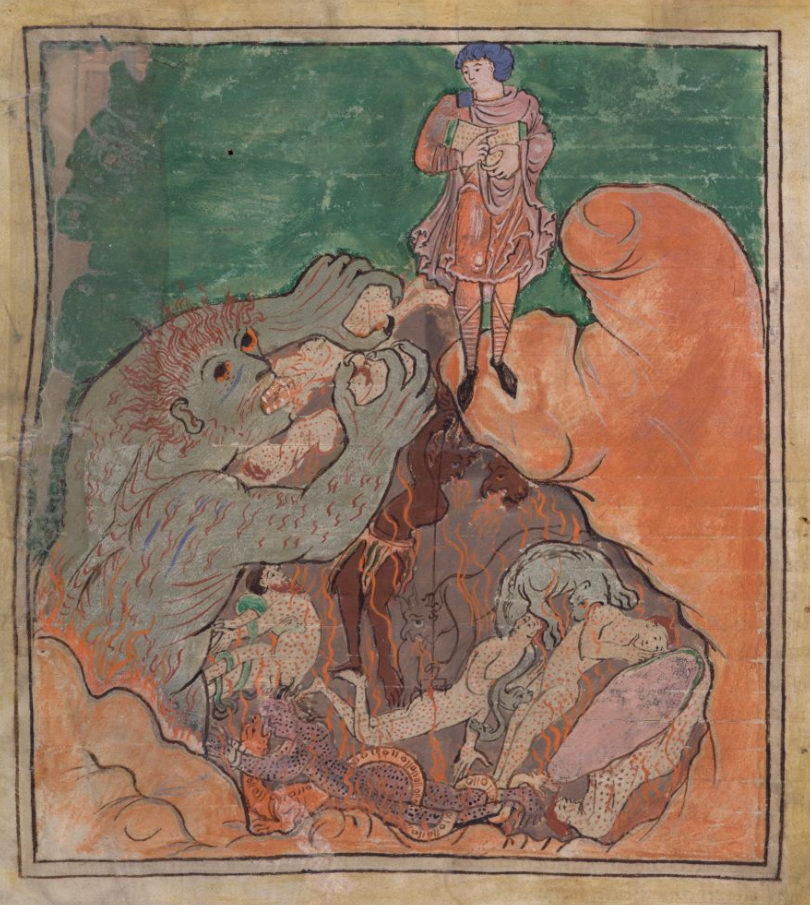
London British Library Cotton Tiberius b v 1 folio 87v - wikicommons
The Penitence of Jamnes and Mambres is the title given to a bilingual apocryphal text found in the eleventh-century London, British Library, Cotton Tiberius B. v manuscript. In two columns, one in Latin, and one in Old English, the text tells about these two brothers, supposedly the Egyptian necromancers who competed against Moses and Aaron in Exodus 7–8 (NB: the image and Latin version of the text are recopied in a post-Conquest manuscript, the twelfth century MS Bodley 614). This text, however, does not tell that story. Instead, the brief narrative relates to us a dramatic moment late in the life of Mambres, after his brother Jamnes has already died. He visits his brother's grave with their old necromantic books and attempts to summon him from the dead. The black magic works, for Jamnes appears. Presumably Mambres was hoping for some divinatory aid or prognostic assistance, but the elder brother acts as older siblings are wont to do: he does not cooperate, instead delivering a brief sermon enjoining his sibling to repent of his evil ways lest he, too, find himself in hell's horrid tortures. The brief narrative ends on this homiletic note, followed by a magnificent full-page illustration of the scene on the next page.
Notably, the brothers are not named in the Hebrew scriptures at all, but are mentioned in the canonical 1 Timothy 3:8, where they epitomize people who resist gospel preaching and missionary efforts. Presumably, the Pauline author of the epistle drew their names from the Greek apocryphon as edited from the fourth-century Chester Beatty papyrus fragments by Pietersma, or a closely related narrative (for the scattered allusions to the brothers from the early Christian and patristic era, see Hall, p. 11). That Greek narrative is not known to have circulated in Latin or in Western Europe at all, though the title paenitentia Iamne et Mambre appears in the Gelasian Decree, which did circulate in England. As such, especially given that their names in the Old English text correspond to the forms found in the Gelasian Decree, but not to the Greek tradition (where they are known as ‘Jannes and Jambres'), it seems likely that the Cotton Tiberius B. v text was composed to fill the lacuna suggested by the decree—somebody knew such a text must have existed, since it was prohibited by name, and so the enterprising scribe penned this brief self-contained account about them based upon 1 Timothy 3:8 and Pharaoh's unnamed court mages in Exodus. Their legend took on a life of its own in early medieval England, for which, see Hall and Biggs; they are twice depicted in the Old English illustrated Hexateuch, accompanying the passages on the miracle of the rods (Exodus 7:12) and the plague of lice (Exodus 8:18). Ælfric refers to them in his homily “on auguries”, and they are briefly mentioned in the anonymous Life of St Margaret, as well as in the Old English Orosius (see Hall p. 11 for references).
Its manuscript context is peculiar: in Cotton Tiberius B. v, it is appended to the Wonders of the East. There has been some debate about why it was added to the end of that text. It was, perhaps, thought of as being of a piece with that work's parade of exotic and magical monstrosities from far-flung lands—these Egyptian mages round out the collection of foreign wonders with biblical lore, and allow for the text to end on a hellfire-inflected homiletic note, as so many Old English texts do.
The full-page illustration that accompanies the text is also worth drawing attention to. It provides a compellingly vivid, colorful, and striking vision of hell, with a gigantic shaggy monster pawing its way out of a heap of fiery corpses, below Mambres, who stands atop a crag holding his book of black magic. It has been argued that the image does not correspond to the narrative very closely (see Clements, and see Hopkins), but that the divergences bear interesting implications that shed light on early medieval English cultural assumptions.
Due to the brevity of the piece, I choose to present the entire Old English text below (to listen a recording, click here):
Her segð hu Mambres ontynde ða drylican bec his breðer Iamnes ond him geopenude þa heagorune ðæs deofelgildes his broður. Andswarode him Iamnes saul þyssum wordum: “Þu broðor, ic naht unrihtlice eom dead ac soðlice and rihtlice ic eom dead and godes dom wið me standeð, for þam ðe ic wæs ana snotæra þonne ealle oðre dryas and ic wiðstod twam gebroðrum, Moyses hatte and Aaron, þa worhtan ða micclan tacna and forebeacn. For þan ic eom dead and for þam ic eom geledd on helwara rice mid, þær is seo miccle bærnys þæs ecan wites and þær is se seað þas singales susles, ðanon ne byð ænig upp adon. [5] Nu, min broðer Mambre, beheald þe on þinum life, þæt þu do wel þinum bearnum and þinum freondum, for þan þe on helle ne byð na wiht godes nemðe unrotnys and þystru. And æfter þam þe ðu dead bist, þonne cymst þu to helle and betwix deadum mannum bið þin eardingstow niðer on eorðan and þin seað bið twegea cubita wid and feowra lang.”
[Here it tells how Mambres unsealed the necromantic books of his brother Jamnes, and he opened up for himself the heathen secrets of his brother's devil worship. The soul of Jamnes answered him with these words, “You, brother—not unjustly am I dead, but truly and rightly am I dead and God's judgment stands against me, for I alone was wiser than all other mages and I withstood the two brothers called Moses and Aaron who worked great signs and wonders. For this am I dead and for this am I now borne into the midst of the kingdom of the hell-dwellers, where there is the great burning of this eternal punishment, and there is the pit for those continuous torments, from which none will be taken up. Now, my brother Mambres, look upon your life, that you do well by your children and your friends, for in hell there will be not a morsel of goodness, only sorrow and shadow. And after that, when you are dead, you will come to hell, and your dwelling place will be between dead men down in the earth, and your pit will be two cubits wide and four long.]
Select Bibliography
Manuscript
London, British Library, Cotton Tiberius B V/1, fol. 87r
Editions
Cockayne, T. O., ed. Narratiunculae Anglice Conscriptae (London: J. R. Smith, 1861).
Förster, Max. ‘Das Lateinisch-Altenglische Fragment Der Apokryphe von Jamnes Und Mambres', Archiv Für Das Studium Der Neueren Sprachen Und Literaturen, no. 108 (1902): 15–28.
James, M. R. 'A Fragment of the “Penitence of Jannes and Jambres”', The Journal of Theological Studies 2 (1901), 572–77.
McGurk, Patrick., D. N. Dumville, Malcolm Godden and Ann Knock, ed. An Eleventh-Century Anglo-Saxon Illustrated Miscellany : British Library Cotton Tiberius B.V Part I Together with Leaves from British Library Cotton Nero D.II, Early English Manuscripts in Facsimile v. 21 (Copenhagen: Rosenkilde & Bagger, 1983).
Pietersma, Albert, ed. The Apocryphon of Jannes and Jambres the magicians: P. Chester Beatty XVI;(with new editions of Papyrus Vindobonensis Greek inv. 29456+ 29828 verso and British Library Cotton Tiberius B. v f. 87); with full facsimile of all three texts. Vol. 119 (Leiden: Brill, 1993).
Criticism
Biggs, Frederick M., and Hall, Thomas N. ‘Traditions Concerning Jamnes and Mambres in Anglo-Saxon England', Anglo-Saxon England 25 (1996), 69–89.
Clements, Jill Hamilton. ‘Warnings from the Grave: Necromancy, Talking Bones, and the Final Marvel of the Wonders of the East', The Review of English Studies 73 (2022), 615–31.
Gero, Stephen. ‘Parerga To “the Book of Jannes and Jambres”', Journal for the Study of the Pseudepigrapha 5, no. 9 (1991), 67–85.
Hall, Thomas N. ‘Jannes and Jambres'. In Sources of Anglo-Saxon Literary Culture: Apocrypha, ed. Frederick M. Biggs, vol. 1. Instrumenta Anglistica Mediaevalia (Medieval Institute Publications, 2007).
Hopkins, Stephen C. E., ‘A Glimpse of Hell: Artistic Inspiration and the Old English Penitence of Jamnes and Mambres', in Material Apocrypha: Christian Apocryphal Narration beyond Text, ed. Janet E. Spittler and Robert M. Calhoun (Sheffield: Equinox, 2026), pp. 101–24.
Hopkins, Stephen C. E. Translating Hell: Vernacular Theology and Apocrypha in the Medieval North Sea (Manchester: Manchester University Press, 2026).
Hurley, Mary Kate. ‘Distant Knowledge in the British Library, Cotton Tiberius B.v Wonders of the East', The Review of English Studies 67 (2016), 827–43.
Meaney, Audrey L. 1985. ‘Ælfric's Use of His Sources in His Homily on Auguries', English Studies 66, 477–95.
Pietersma, A. ‘The Apocryphon of Jannes and Jambres', in Congress Volume Leuven 1989, ed. J. A. Emerton, vol. 43, Vetus Testamentum, Supplements (Leuven, 1991).
Price, Jocelyn G. ‘The Virgin and the Dragon: The Demonology of Seinte Margarete', Leeds Studies in English (1985), 337–57.
Roby, Matthew. ‘Eating People and Feeling Sorry: Cannibalism, Contrition, and the Didactic Donestre in the Old English Wonders of the East and Latin', in Darkness, Depression, and Descent in Anglo-Saxon England, ed. Ruth Wehlau (De Gruyter/Medieval Institute Publications, 2019), pp. 167–208.
Semple, Sarah. ‘Illustrations of Damnation in Late Anglo-Saxon Manuscripts', Anglo-Saxon England 32 (2003), 231–45.
About the author
Stephen Hopkins (stephen.hopkins@virginia.edu) is Assistant Professor of Old English at the University of Virginia, where he teaches courses on Old English language and literature, Old Norse language and literature, book history and the history of the English language. His first book, Translating Hell: Vernacular Theology and Apocrypha in the Medieval North Sea, is forthcoming (2026) with Manchester University Press.