

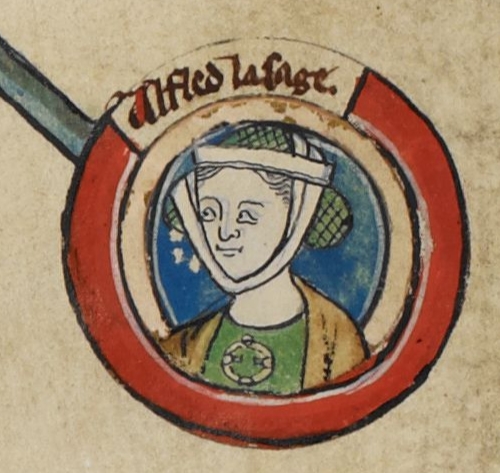
The Mercian Register is a lost chronicle that survives as a fragment in three manuscripts of the compilation of texts known collectively as the “Old English Chronicles” (or “Anglo-Saxon Chronicles”). The extant Register comprises a set of annals that record events in Mercia chronologically between 902 and 924/926 CE. It constitutes a major source for the early medieval history of the west Midlands and for the career of one of the tenth-century’s most influential rulers: Æthelflæd, Lady of the Mercians. Although laconic and paratactic in style, the annals nevertheless articulate a distinctly Mercian perspective on a formative period in the consolidation of Mercia and, subsequently, the formation of England.
The ‘little Mercian Register’, as it was called by early editors, survives in the Old English Chronicle manuscripts B (London, British Library, Cotton MS Tiberius A VI, fols 30r–31v, dating from the late tenth century), C (London, British Library, Cotton MS Tiberius B I, fols 140r–141r, dating from the mid-eleventh century), and D (London, British Library, Cotton MS Tiberius B IV, dating from the mid- to late-eleventh century). B and C are closely related. In these versions, the Register comprises sixteen short annals (seventeen in C), beginning in 902 and breaking off mid-sentence in 924. They are inserted en bloc in the main Chronicle between entries for 915 and 934, notably out of sequence and separated by a series of blank years. D, a later redaction, does not preserve a distinct, contiguous block of text as in B and C, but integrates the Mercian material more fully into its chronological framework, augmenting and combining its entries with information about Worcester and the northern kingdoms during this period.
Composed in Old English, the Register stands apart from many other histories composed and copied in Latin in early England, and from other annalistic texts on the continent. Its language and annalistic form align it with the Old English Chronicles, with which it circulated, and suggest that it may originally have been conceived as a Mercian continuation of the Alfredian Chronicle project — a cultural enterprise spanning both Mercian and West-Saxon spheres. The incorporation of Mercian history into the dominant West-Saxon narrative of the main Chronicle, however, was neither seamless nor ideologically harmonious.
The Register is generally thought to have been composed in Mercia and linked to its established traditions of learning and literary production. Its favourable presentation of Æthelflæd has prompted suggestions that it was commissioned by her, or at least initiated during her lifetime in support of her rule and that of her successors, hence its alternative title, “the Annals of Æthelflæd”. Linguistic evidence has led some scholars to propose a more specific origin at Worcester between c. 902 and 924, possibly under the direction of Wærferth, Bishop of Worcester, a leading Mercian scholar who contributed to Alfred’s programme of vernacular learning. While Wærferth remains an attractive candidate, the identity of the chronicler (or chroniclers) cannot be established with certainty, and it is important not to exclude the possibility that the Register was compiled by a woman with access to Mercian materials and a predilection for the stories of Mercian royal women.
Æthelflæd’s political career forms the main focus of the Register. She was the daughter of Ealhswyth, a Mercian noblewoman, and Alfred the Great, and the Register records her defence of Mercia against the Vikings and Irish Norse, her dealings in Wales, and treatise in the North. She ruled jointly with her husband Æthelred until his death in 911 and thereafter as sole leader of the Mercians, though the Register records her acting independently from at least 910. Many entries focus on the burhs, which were fortifications readied for military action against the Vikings. In B and C, thirteen burhs are recorded as reclaimed, rebuilt, or newly founded between 902 and 918, often strategically located along Mercia’s borders with Viking-held territories to the north and east, or the western frontier with Wales, where only the southern Welsh kingdoms were precariously allied. The cumulative impression is of a kingdom under sustained pressure on almost every side, yet militarily and politically strong.
The Register carefully emphasises the legitimacy of Æthelflæd’s rule during this period. On her death in 918, it records that this was þy eahtoþan geare þæs þe heo Myrcna anwald mid riht hlaforddome healdende wæs (‘the eighth year in which she had held power over the Mercians with right lordship’). In the Register, she is referred to consistently with the title Myrcna hlæfdige, the female counterpart to her husband’s title Myrcna hlaford, which can be translated as ‘Lady of the Mercians’ or ‘(female) Lord’. There is ongoing debate as to the power vested in a hlæfdige in comparison with a hlaford or indeed cwen (queen), as Æthelflæd is called in other historical sources such as the Annals of Ulster. Although the Lord and Lady of the Mercians were technically subject to West-Saxon overlordship following Alfred’s appointment of Æthelred to prevent Mercia and its vacant throne falling into Viking hands, the Register describes Æthelflæd as exercising substantial authority over all the Mercians. In 913, for instance, she went mid eallum Mrycum to Tamaweorðige 7 þa burh ðær getimbrede (‘with all of the Mercians to Tamworth and built the burh there’), the ancient seat of Mercian power. In 916, moreover, she captured the southern Welsh queen of Brycheiniog and her retinue, and in 918 she secured Leicester gesimbsumlice (‘peacefully’) and received the allegiance of the people of York, who swore loyalty to her, sume on wedde geseald, sume mid aþum gefæstnod, þæt hie on hire rædenne beon woldan (‘some giving pledges, and some bound by oaths, so that they would remain under her rule’). Whether thought of as a hlæfdige, or cwen, Æthelflæd’s rule is presented here as a legitimate and popular among the Mercians.
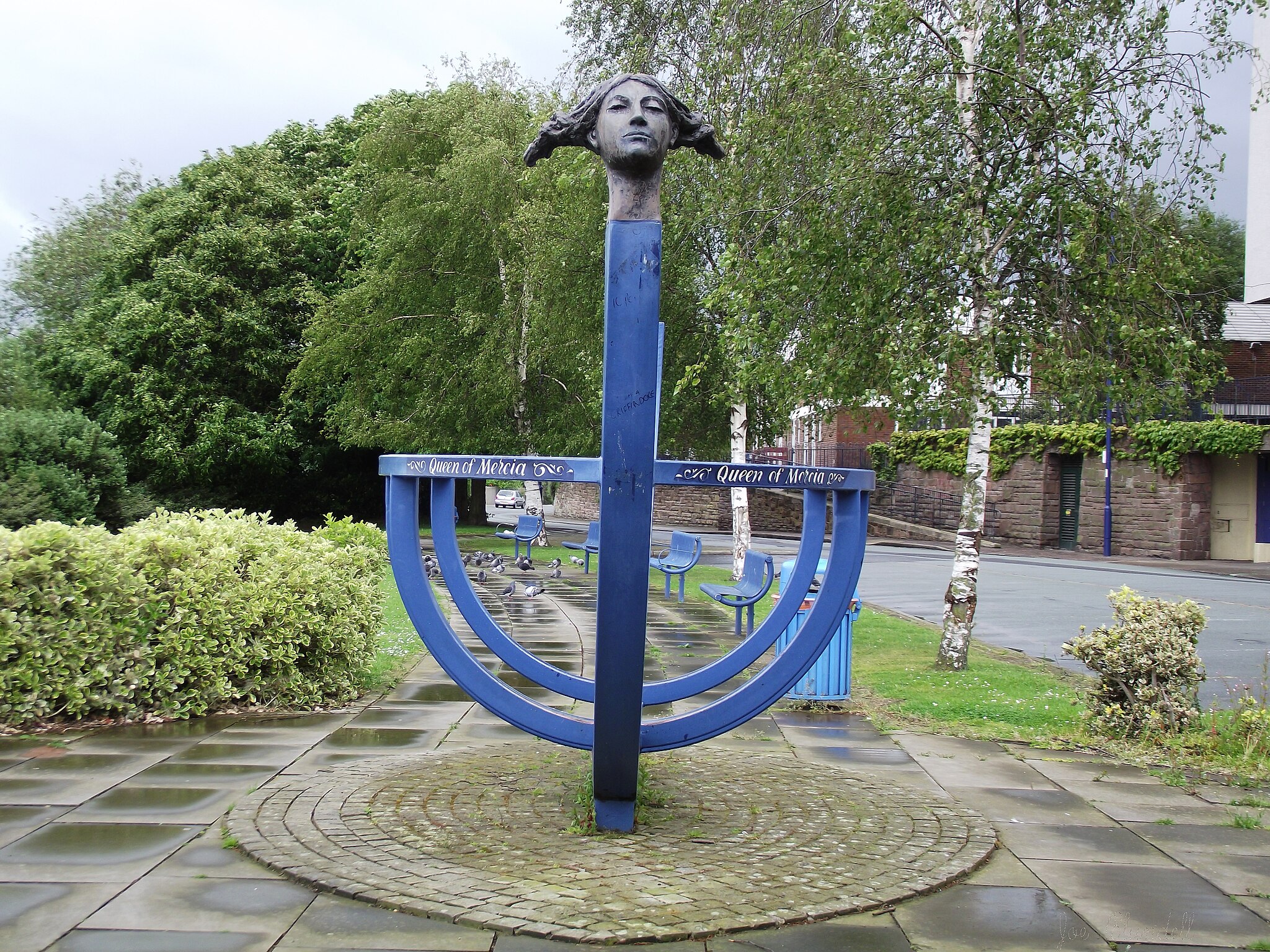
The Register also includes further noteworthy references to other Mercian noblewomen. B and C take the death of Ealhswyth in 902 as their watershed moment: Her Ealhswyð forðferde (‘Here Ealhswyth died’). After Æthelflæd’s death, her daughter Ælfwynn briefly succeeded her before she was ælces onwealdes on Myrcum benumen (‘deprived of all authority among the Mercians’) and on Westsexe alæded (‘led into Wessex’) in 919. Although her rule was short-lived, it appears to be the first recorded instance in English history of a woman inheriting rule from her mother. The annals conclude in 924 with the accession of Æthelstan, Æthelflæd’s nephew, who wæs of Myrcum gecoren to cinge (‘was chosen by the Mercians as king’), notably not as hlaford, and with the marriage of his unnamed sister overseas, whereupon B and C break off mid-sentence. The predominance of female figures in the Register is striking within the vernacular chronicle tradition, where women are referenced with comparatively less frequency and none with the same sustained attention as Æthelflæd here receives. While this emphasis may reflect the particular interests of a Mercian compiler, it may also have been the case that Mercian noblewomen were foregrounded because they helped to shape a genealogy that may have opened with a vacant Mercian throne, but culminated in a sovereign Mercian king, Æthelstan, also later known as the first king of the English (rex Anglorum).
Equally significant to the story are the Register’s silences. B and C make no mention of Æthelflæd’s famous West-Saxon father and record Edward’s death only briefly. C has one additional entry in 921 that Edward getimbrede(‘fortified’) the burh at Cledemuþan in Mercia. Military campaigns, such as the raid on Bardney in 909 or victory at Leicester in 918, are treated as exclusively Mercian rather than joint Mercian-West-Saxon victories in B and C, which contrasts with their representation in the West Saxon annals. When considered alongside the disgruntled tone of Ælfwynn’s deposition, such details suggest a reluctance on the part of the Mercian chronicler to foreground West-Saxon overlordship during this period. Selection and omission thus tell their own story of Mercia’s distinct political interests and cultural identity.
The Register also frames Mercia as a Christian polity. Three entries explicitly attribute Æthelflæd’s actions to divine aid: in 913, when she led the Mercians to Tamworth, Gode forgifendum (‘with God’s help’); and in 917 and 918, Gode fultmigendum (with God’s aid) and Godes fultome (‘with God’s support’), she acquired Derby and Leicester. Several military victories in 912 and 916 are dated with reference to the liturgical calendar, namely the Invention of the Cross and the feast day of Saint Cyriacus. Saint Oswald is also venerated when his relics are translated in 909. None of these hagiographical references are to “regional” Mercian saints, but rather “foreign” or more “universal” figures: the discovery of the Cross by a Roman empress and Jewish leader in Jerusalem; a child martyr from Tarsus; and a Northumbrian warrior-king. Given this, these references may have been included to reshape Æthelflæd’s rule specifically, and Mercian history more broadly, as participating in the global history of the Church, as well as God’s unfolding plans (His providence) for humanity.
The extant versions of the Register advance subtly different interpretations of the early tenth century. Taken together, however, their form and language suggest that dynastic concerns and familial politics shaped the Register’s composition; it may, therefore, have participated in a broader cultural enterprise to articulate a shared ‘Anglo-Saxon’ (at once Mercian and West-Saxon) identity as resilient and united in the face of Scandinavian incursions. At the same time, the emphasis on Mercia’s political interests and achievements, its expansion into Danish-held territories, and its capacity for autonomous rule resists any straightforward subsumption of Mercian history within a West-Saxon narrative. In this respect, the Register may be read as offering a form of political commentary on the developing union between Mercia and Wessex during this period, perhaps even gesturing towards a residual separatist sentiment. Moreover, the Christian references frame Mercian success in providential terms and situate its history within the rhythms of the wider communion of the Church, thus pointing to the possibility that the Register advocated the belief that the unity and prosperity of politically distinct kingdoms were secured principally through a shared faith, one Church, and a common salvific mission.
These possible interpretations depend largely upon perceived consistencies and thematic threads across the Register. But how should its remaining textual irregularities and pronounced parataxis be understood? The recording of meteorological phenomena is one such example. Following Ealhswyth’s death, B and C note an eclipse (904) and a comet (905). D likewise includes the comet and, under 926, reports that oðeowdon fyrena on norðdæle þære lyfte (‘fiery rays appeared in the northern sky’), alongside entries for 925 and 926 concerning Æthelstan’s relations with the kings of Northumbria and of Northern and Western Britain. Celestial signs of this kind held interest for early medieval chroniclers, and could be varyingly calculated and also moralised as omens of change, portending crisis, political upheaval, or communal renewal. None of the extant versions of the Register, however, makes their meaning explicit; their significance, if any, must be inferred from context. In B and C, meteorological phenomena precede a period of relative political stability and prosperity for the Mercian people. In D, they frame a narrative that appears to trace Mercia’s resurgence as a major power within Britain. It is possible that such signs did not proscribe meaning but invited reflection upon the historical events. Set against a background of warfare, all three versions shape reflections on the survival and success of nations; in difficult times, should one look to military strength, leaders, the Church, or the heavens?
Celestial signs also raise a more fundamental question about the writing and interpretation of history itself, especially chronicles: namely, how far did the chronicler allow for the negotiation of meaning across events, revisions, and retrospective adaptation, inevitably shaped by the contingencies of an unfolding and uncertain future? It is questions of this kind that help to explain the enduring appeal and significance of the Mercian Register, and of Old English historiography more generally. For this chronicler, at least, history was not merely a record of events; it was an act of interpretation, by which the interplay of competing ideological commitments and the discernment of meaning shaped the terms upon which Mercia’s future was being negotiated.
Select Bibliography
Editions
Anglo-Saxon Chronicle: A Revised Translation, Version A, ed. Dorothy Whitelock with David C. Douglas and Susie I. Tucker (London: Eyre and Spottiswoode, 1961; published online by Cambridge University Press 2011).
The Anglo-Saxon Chronicle: A Collaborative Edition, vol. 4: MS B, ed. Simon Taylor (Cambridge: D. S. Brewer, 1983).
The Anglo-Saxon Chronicle: A Collaborative Edition, vol. 5: MS C, ed. Katherine O’Brien O’Keeffe (Cambridge: D. S. Brewer, 2001).
The Anglo-Saxon Chronicle: A Collaborative Edition, vol. 6: MS D, ed. G. P. Cubbin (Cambridge: D. S. Brewer, 1999).
Secondary Reading
Anlezark, Daniel. Constructing the Anglo-Saxon Chronicles (Cambridge: D. S. Brewer, 2025).
Bailey, Maggie. ‘Ælfwynn, Second Lady of the Mercians’, in Edward the Elder 899–924, ed. N. J. Higham and D. H. Hill (London: Routledge, 2001), pp. 112–27.
Brooks, N. P. ‘The Church in Mercia’, in Mercian Studies, ed. A. Dornier (Leicester: Leicester University Press, 1977), pp. 145–65.
Foot, Sarah. ‘Finding the Meaning of Form: Narrative in Annals and Chronicles’, in Writing Medieval History, ed. Nancy Partner (London: Hodder Arnold, 2005), pp. 88–107.
Hardie, Rebecca, ed. Æthelflæd, Lady of the Mercians, and Women in Tenth-Century England (Publications of the Richard Rawlinson Center) (Berlin, Boston: De Gruyter, 2023).
Jorgensen, Alice, ed. Reading the Anglo-Saxon Chronicle: Language, Literature, History (Turnhout: Brepols, 2010).
Stafford, Pauline. After Alfred: Anglo-Saxon Chronicles and Chroniclers, 900–1500 (Oxford: Oxford University Press, 2020).
—. ‘“The Annals of Æthelflæd”: Annals, History and Politics in Early Tenth-Century England’, in Myth, Rulership, Church and Charters, ed. Julia Barrow and Andrew Wareham (Aldershot: Ashgate, 2008), pp. 101–16.
—. ‘Political Women in Mercia, Eighth to Early Tenth Centuries’, in Mercia: An Anglo-Saxon Kingdom in Europe, ed. M. P. Brown and C. A. Farr (London: Continuum, 2001), pp. 35–49.
Wainwright, F. T. ‘Æthelflæd, Lady of the Mercians’, in The Anglo-Saxons: Studies in Some Aspects of Their History and Culture Presented to Bruce Dickins, ed. Peter Clemoes (London: Bowes & Bowes, 1959), pp. 53–70; reprinted in Scandinavian England: Collected Papers by F. T. Wainwright, ed. H. P. R. Finberg (Chichester: Phillimore, 1975), pp. 305–324.
—. ‘The Chronology of the “Mercian Register”’, English Historical Review 74 (1959), 1–17.
Winkler, Emily A. ‘Æthelflæd and Other Rulers in English Histories, c.900–1150’, English Historical Review 137 (2022), 969–1002.
About the author
Rebecca Hardie is currently a postdoctoral researcher at EXC 2020 Temporal Communities: Doing Literature in a Global Perspective, Freie Universität Berlin. She is the editor of Æthelflæd, Lady of the Mercians, and Women in Tenth-Century England (Berlin/Boston: De Gruyter, 2023).